Fruits

Banana Nutrition Facts
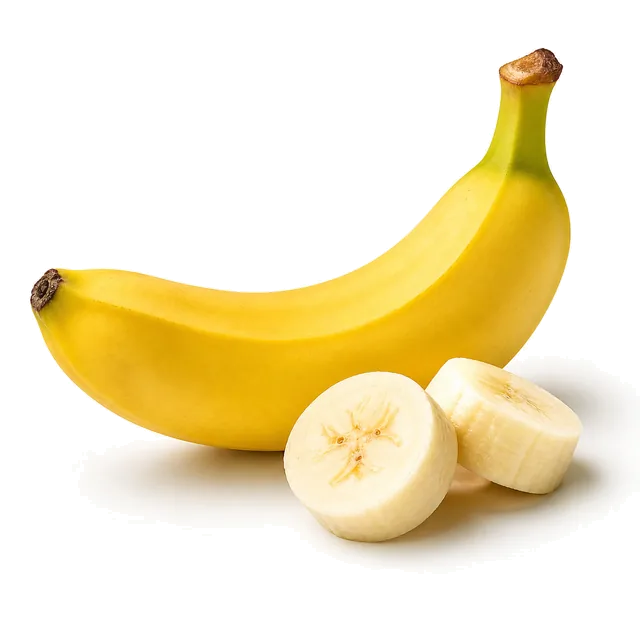
Banana

Banana is a convenient source of carbohydrate and potassium. Greener fruit contains more resistant starch; as ripening advances, starch is converted into sugars, so a ripe banana tastes sweeter and can provide readily available carbohydrate around training. Potassium supports normal muscle function, but eating a banana has not been shown to prevent or rapidly treat exercise-associated cramps.

Calories97
Protein0.7 g
Carbs23 g
Fat0.3 g
ProteinCarbsFat

Nutrition for 100 g

Calories97 kcal
Protein0.7 g
Total Fat0.3 g
Carbohydrates23 g
Fiber1.7 g
Total Sugars15.8 g
Sodium0 mg
Nutrients

Full nutrient profile

Proximates
Water75.3 g
Nitrogen0.12 g
Protein0.74 g
Total lipid (fat)0.29 g
Ash0.7 g
Carbohydrates
Carbohydrate, by difference23 g
Carbohydrate, by summation21.2 g
Fiber, total dietary1.7 g
Total dietary fiber (AOAC 2011.25)4.62 g
Sugars, Total15.8 g
Sucrose4.18 g
Glucose5.55 g
Fructose6.09 g
Lactose0 g
Maltose0 g
Galactose0 g
Starch3.66 g
Sugars, Total12.23 g
Organic acids
Citric acid341 mg
Malic acid369 mg
Minerals
Calcium, Ca5 mg
Iron, Fe0 mg
Magnesium, Mg28 mg
Phosphorus, P22 mg
Potassium, K326 mg
Sodium, Na0 mg
Zinc, Zn0.16 mg
Copper, Cu0.101 mg
Manganese, Mn0.258 mg
Iodine, I0 ug
Selenium, Se0 ug
Fluoride, F2.2 ug
Vitamins and other components
Vitamin C, total ascorbic acid12.3 mg
Thiamin0.056 mg
Riboflavin0 mg
Niacin0.662 mg
Vitamin B-60.209 mg
Biotin0 ug
Folate, total14 ug
Vitamin A, RAE1 ug
Carotene, beta8 ug
cis-beta-Carotene1 ug
trans-beta-Carotene7 ug
Carotene, alpha7 ug
Cryptoxanthin, beta0 ug
Cryptoxanthin, alpha0 ug
cis-Lycopene0 ug
trans-Lycopene0 ug
cis-Lutein/Zeaxanthin0 ug
Vitamin K (phylloquinone)0.1 ug
Vitamin K (Dihydrophylloquinone)0 ug
Vitamin K (Menaquinone-4)0 ug
Folic acid0 ug
Vitamin D (D2 + D3), International Units0 iu
Vitamin A, IU64 iu
Folate, food20 ug
Choline, total9.8 mg
Folate, DFE20 ug
Betaine0.1 mg
Retinol0 ug
Vitamin B-120 ug
Vitamin B-12, added0 ug
Vitamin E, added0 mg
Vitamin D (D2 + D3)0 ug
Lycopene0 ug
Tocopherol, delta0.01 mg
Tocotrienol, gamma0 mg
Tocotrienol, delta0 mg
Lutein + zeaxanthin22 ug
Tocopherol, beta0 mg
Tocopherol, gamma0.02 mg
Tocotrienol, alpha0.06 mg
Tocotrienol, beta0 mg
Pantothenic acid0.334 mg
Vitamin E (alpha-tocopherol)0.1 mg
Lipids
Fatty acids, total saturated0.112 g
SFA 8:00 g
SFA 12:00.002 g
SFA 14:00.002 g
PUFA 22:6 n-3 (DHA)0 g
MUFA 16:10.01 g
PUFA 20:5 n-3 (EPA)0 g
PUFA 22:5 n-3 (DPA)0 g
SFA 4:00 g
SFA 6:00 g
SFA 10:00.001 g
SFA 16:00.102 g
SFA 18:00.005 g
MUFA 18:10.022 g
PUFA 18:20.046 g
PUFA 18:30.027 g
PUFA 20:40 g
PUFA 18:40 g
MUFA 20:10 g
MUFA 22:10 g
Fatty acids, total monounsaturated0.032 g
Fatty acids, total polyunsaturated0.073 g
Fatty acids, total trans0 g
Cholesterol0 mg
Phytosterols16 mg
Amino acids
Tryptophan0.009 g
Threonine0.028 g
Methionine0.008 g
Phenylalanine0.049 g
Tyrosine0.009 g
Alanine0.04 g
Glutamic acid0.152 g
Glycine0.038 g
Proline0.028 g
Isoleucine0.028 g
Leucine0.068 g
Lysine0.05 g
Cystine0.009 g
Valine0.047 g
Arginine0.049 g
Histidine0.077 g
Aspartic acid0.124 g
Serine0.04 g
Other bioactive components
Alcohol, ethyl0 g
Caffeine0 mg
Theobromine0 mg
Practical guidance

How to choose and store Banana

How to choose

Pick the ripeness you need: green-tipped bananas ripen over a few days at home, while evenly yellow fruit with light brown speckling is sweet and ready now. Avoid deep bruises, split skins or a fermented smell.

Storage

Keep at room temperature until ripe, then refrigerate to slow further ripening — the skin darkens but the fruit inside stays good for days. Peel and freeze over-ripe bananas for smoothies or baking.